


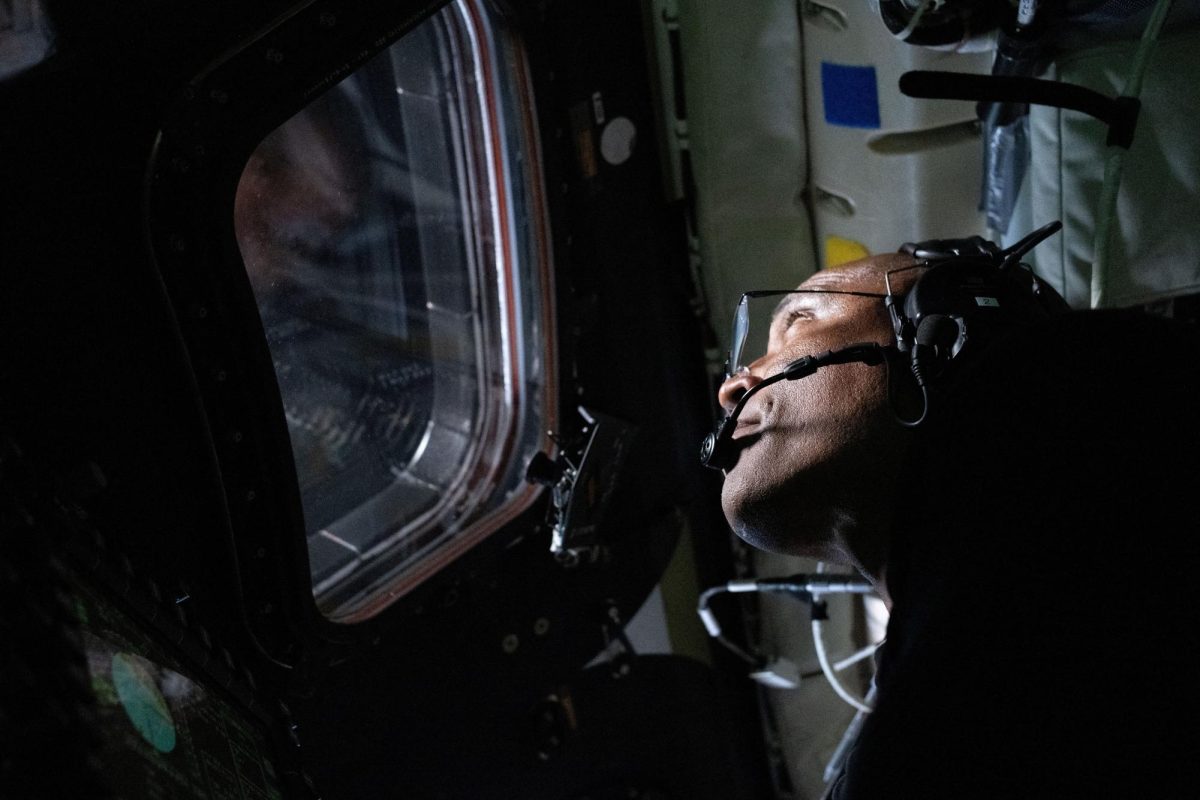

With the launch of Artemis II came records broken involving space travel, gender and racial advances.
Artemis II is a part of NASA’s program that is focused on getting humans onto the Moon. Artemis II launched on April 1 from the Kennedy Space Center in Florida. The goal of Artemis II is for the Orion Spacecraft to orbit around the Moon, and then return to Earth, according to the European Space Agency.
According to Space.com, the Artemis II spacecraft has reached the farthest point from Earth than anyone in history, breaking the record set by the Apollo 13 Spacecraft in 1970.
Crew member and Canadian Mission Specialist, Jeremy Hansen, stated, “we, most importantly, choose this moment to challenge this generation and the next to make sure this record is not long-lived,” according to Space.com.
With this being the first time since Apollo 13 that the moon has been explored, this opens up discoveries about space.
MCHS Science Teacher, Eric Jones, explains the significance of the Artemis II launch.
“We haven’t been back to the moon in about 50 years,” Jones says, “so we’re finding out if we have the technology to make that happen … it will hopefully lead to us being able to have a more permanent presence on [the Moon] where we can do more extended experiments and learn more about how that would affect people.”
Other than breaking boundaries involving space travel, though, the Artemis II crew has broken boundaries involving race and gender.
One of the four crew members is Christina Koch. Koch has been a NASA astronaut since 2013, and has already broken records before Artemis II. According to NASA, Koch set a record for the longest single spaceflight by a woman, with a total of 328 days in space, and participated in the first all-female spacewalk.
With Artemis II, Koch was the first woman and a part of the first group of astronauts to fly around the Moon.
In an interview with Brilliant Star Magazine, Koch talks about how she deals with being a woman in a male-dominant field.
“I also think one of the biggest challenges is not really knowing what is difficult because you are part of an underrepresented group,” Koch says, “ or this is just difficult because it’s just difficult?”
Koch explains how she has had to find different approaches in pepping herself up, while dealing with the typical stereotypes of being a woman in her field.
“But I learned about this thing called stereotype threat,” Koch says, “which means that people actually do worse when they think that they are being judged based on a stereotype.”
Koch explains how her thinking changed after learning about stereotype threats.
“I would just tell myself over and over again, ‘they know I’m really, really good at this,’” Koch says, “it didn’t matter that I didn’t actually believe that. But that was kind of something that helped me overcome some of those stereotypes that would creep in and hurt how I did.”
As a woman, Koch has had to find new ways to find success in her field and has learned with time what works best for her.
Another major achievement by Artemis II is that the Pilot, Victor Glover, will be the first Black person to travel to deep space.
Glover has been a NASA astronaut since 2013, and is the pilot of Artemis II’s trip to the Moon.
Glover shares how he views the idea of race and identity’s involvement in this record-breaking trip in a Fox News broadcast.
Glover explains in this interview that he hopes for a future where milestones like his are no longer defined by “firsts,” emphasizing that the upcoming moon mission should be seen as part of shared human history rather than identity-based achievement.
The spacecraft is expected to land today in the Pacific at 7:07 p.m. CST.
As the spacecraft comes back to Earth, it will be not only a record-breaking event for humanity but also a motivator for future generations to go farther.