


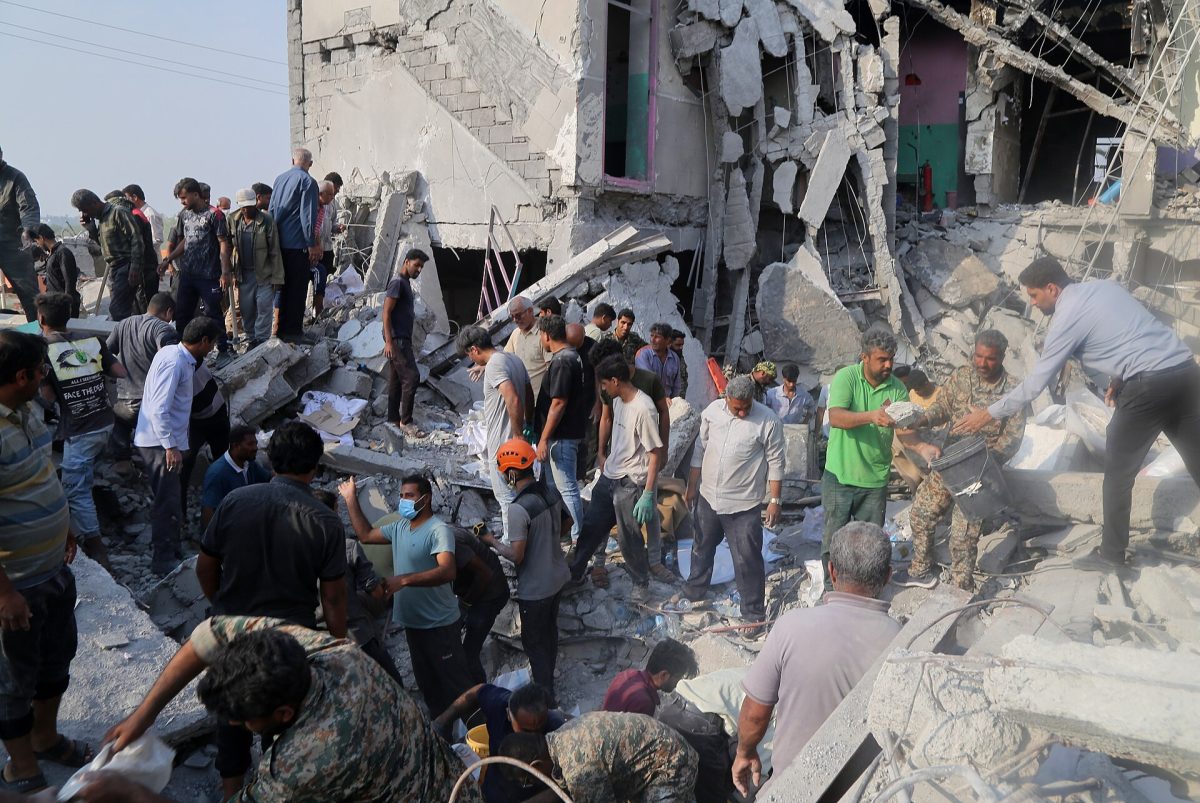

Ask the U.S. and we’d say that it’s okay not to double check your intel, it’s okay to bomb an Iranian school based on outdated intelligence, it’s okay to be funding Israel’s expansion while we are over $38 trillion in debt. Put on your “I love Israel” shirts because as a nation, we are completely and utterly in their pocket.
The U.S. stayed neutral with most other countries until the 1941 Lend-Lease Act authorized them to lend ships, planes, weapons and ammunition.
Since recognizing them as a country, the U.S. has been on friendly terms with Israel. The two became official allies around 1967, when the U.S. matched Soviet Union arms donations to Arab countries in fear of Israel military decimation by the other Middle Eastern countries.
The U.S. was one of the founding members of the United Nations, in which the core ideas are to prevent war and oppose belligerent powers. The UN has established that Israel has committed a genocide on the gaza strip, but the U.S. continues to fund this.
To assume the U.S. is unaware of this genocide would be an act of purposeful ignorance.
This would assume that the U.S. does not keep up with the UN, and the U.S. does not keep tabs on protests across America. Boycotts have been happening, as that is almost entirely all a citizen could do to showcase their disapproval.
It is important to mention that this is not a matter of Republicans versus Democrats. All three main candidates in the 2024 election supported Israel and have spoken on this, including Donald Trump, Joe Biden and Kamala Harris.
Harris says that she believes in Israel’s right to defend themselves but is devastated by Palestinian suffering.
Trump says he doesn’t pick sides, or other people make that case for him, but look at how much money he’s letting the U.S. put in Israel’s pockets. Fence-sitting does not equate to support, and words don’t matter nearly as much as money. Trump says he does not support Israel, and has proposed peace plans with them and Palestine.
Who a country supports is who they give arms to kill with. Who a country supports is who they start wars for. It doesn’t matter what politicians say.
In the 1960s, the U.S. imposed trade sanctions on Cuba. Something I won’t do is pretend that this was entirely for humanitarian reasons. The U.S. stands most of all for gain and money, and was bitter about the new leadership Fidel Castro’s ties to communism. This meant, for the U.S. economy, they could no longer dominate the Cuban economy.
Cuba though, was brutal. Human rights abuses were evident in the executions and labor camps. To support this would have been inhumane.
There were several reasons to pull out of Cuba, just like there are several reasons to pull out of Israel, yet the government has still felt ethical supporting genocide.
Next time the U.S. took a stand, it was under pressure. The Reagan administration held an attitude that Apartheid South Africa was an ally because they were vocally anti-communist in a time where the Cold War was the biggest concern of the U.S. Nelson Mandela, one of the biggest Anti-Apartheid activists, was alleged to have ties to the South African Communist Party. Reagan vetoed the Anti-Apartheid act, and congress overrode it.
Checks and balances are something that you learn about in U.S. history. The concept that’s applicable here is that the president can veto bills that pass congress, and congress can override presidential veto. Currently, this system is hardly in place. One of the biggest protests I’ve seen is democrats wearing pink to Trump’s first address to congress, but protests are most appropriate for citizens who can’t do anything, not officials who can.
Protest. That’s all we can really do. That’s the best thing you can do, aside from run for office and hope to be the exception. If you really want to make a change, you have to show how displeased you are with the current state of things. With enough displeasure, we’ve got to hope something will change.