


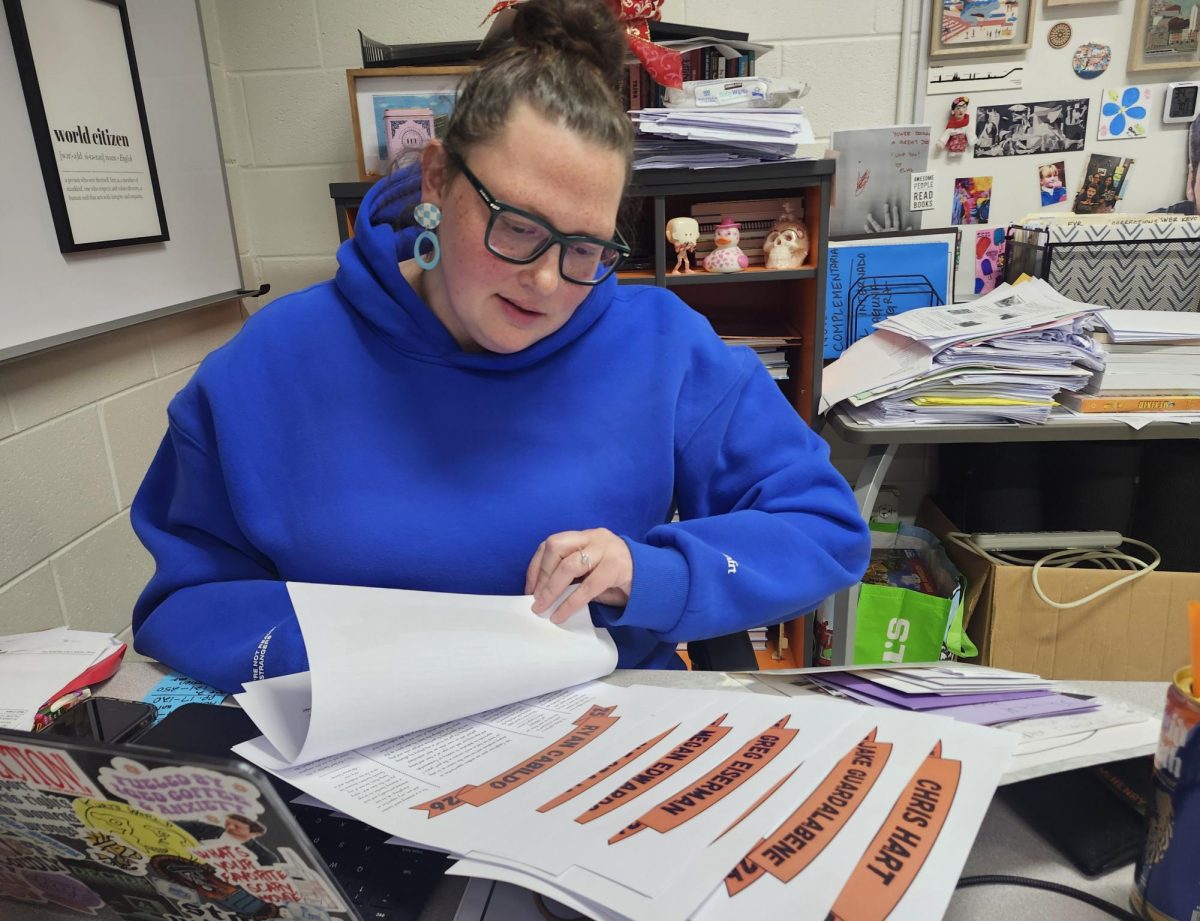

English teacher Belinda Flynn sits in her room on her lunch break, planning lessons for the next day, when building substitute Kayleigh Jensen walks in. They talk for a minute, and before Jensen leaves, she gives Flynn a poster full of notes from her students, telling her how much they appreciate her.
Three years ago, Jensen started a project to recognize the staff during Teacher Appreciation Week. The project consists of a Google form for students to leave notes for any staff members, telling them why they are important. In its first year, there were 450 entries, in the second year, 1200 and this year, there are close to 1300.
Toward the end of Teacher Appreciation Week, which falls on the week of May 5, these notes from students are compiled into a poster, and each teacher receives their poster.
“It’s a way to allow the students to let the teachers know that they appreciate them,” Jensen says, “because there are definitely days where we don’t know if we’re doing the right thing or if we’re making an impact at all.”
Teachers experience burnout in the same way as students, but they don’t get the same encouragement that they give students. This is one of the factors that leads to one in seven public school teachers either moving schools or leaving the profession altogether, according to the Learning Policy Institute.
Students need to reciprocate this encouragement, but it can be hard for them to know how.
“It feels easier to tell my teachers [I appreciate them] when I’m more connected to them,” junior Madelyn Jepsen says, “but with some teachers, I don’t feel that comfortable doing it.”
Most students give a certain amount of respect to their teachers just based on the fact that they are older and in a position of power. This creates a dynamic that is much different from that between two students of the same age.
“It’s completely different to say ‘I appreciate you’ to a friend or someone else in my class,” Jepsen says, “than it is to say that to someone years older than me.”
This is what makes it difficult for many students to say these things to their teachers, even if they truly want to.
“In some classrooms,” Jensen says, “I’m hearing kids say great things about their teachers, but they never say it to them.”
Teachers don’t hear often enough that they are appreciated, so it can come as a surprise to see these messages when they do.
“There have been messages from students who hardly said a word in class, letting me know that I was their favorite teacher,” English teacher Margaret Carhart says, “and that was so humbling and heart-warming!”
Teachers are always looking to grow, but they are also looking for reassurance that what they’re doing isn’t going to waste. When they receive these notes from their students, it shows that their job is important and they are truly making a difference in their students’ lives.
“As teachers, we often don’t recognize the lasting impact we’ve had on our students,” Carhart says. “ … These messages of belief give me the energy to keep working hard even when I don’t always see or hear about the difference I’m making.”
Teacher Appreciation Week isn’t only about students recognizing their teachers, it’s also about teachers encouraging and giving advice to each other.
“Learning is messy,” Flynn says. “Don’t be afraid to make mistakes and learn from [your students].”
Flynn goes to hang up her new poster when one note catches her eye. “You make me feel seen,” it says. As the bell rings and students start to fill the room, Flynn can see that she’s not just teaching, she’s creating a safe environment for them to grow.