

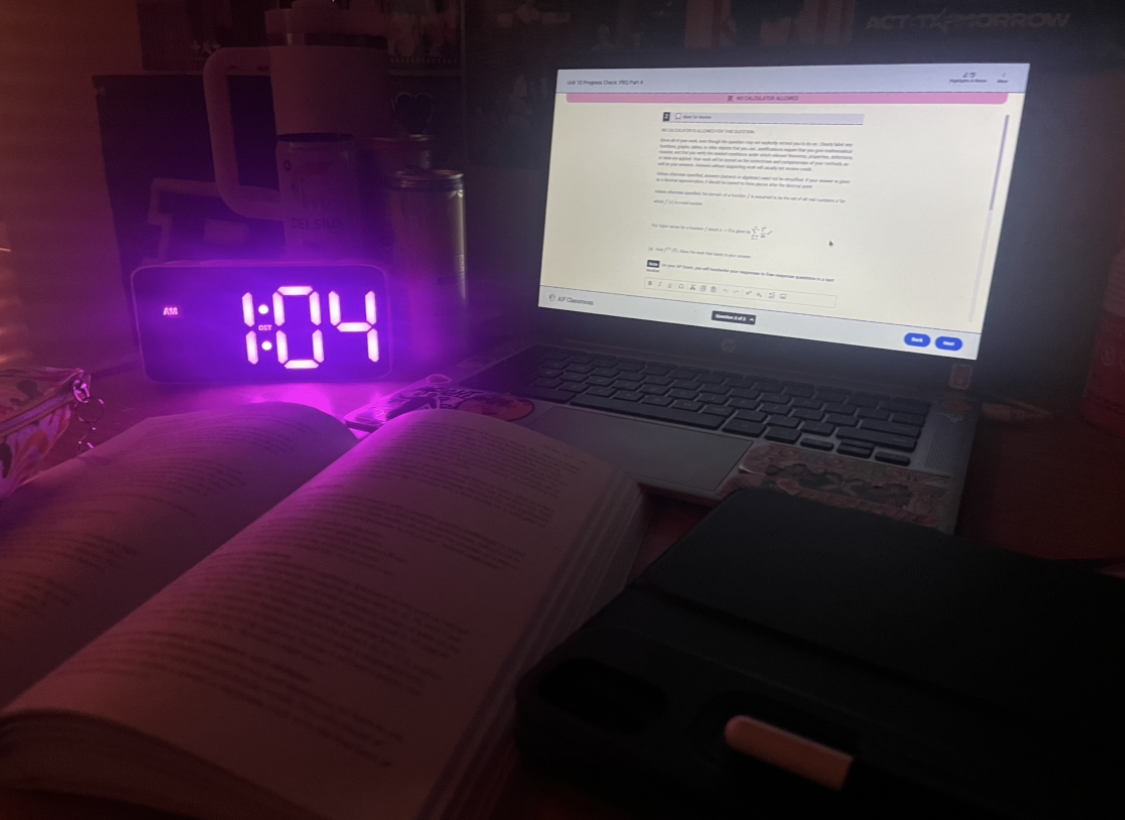
A student stares at her blank doc. It’s three in the morning, and she’s left the essay due for her AP Literature class at the end of her checklist. After doing AP Government notes, a calculus FRQ and a lab report, all she wants to do is close her eyes and go to bed. Little does she know, she’ll repeat this process tomorrow, and the day after that, and so on.
It’s pretty common for high school students – especially those of the “high achieving” standpoint – to get little or no sleep. It’s even more common for them to become burnt out because of this.
According to the National Library of Medicine, teens get (on average) less than six and a half hours of sleep per night on weekdays. The average adolescent requires between eight and a half to nine and a quarter hours of sleep per night to feel rested.
“I’m much more of a night owl,” says Ayomide Adetowoju, senior at MCHS. “I think I get about five hours of sleep. That’s not okay, though.”
Students at MCHS get less than half the amount of sleep they need, making it hard to stay on top of things.
“I’d say I get about three hours every night because I procrastinate on my work and refuse to get it done,” says Kaitlyn Norris, senior at MCHS.
Students often turn to energy drinks to make up for their lack of sleep. However, energy drinks don’t necessarily make you more energized – all they do is block the receptors in your brain that tell you when you’re tired.
“I used to rely on energy drinks a lot during junior year,” says Adetowoju. “It was pretty rough, and did nothing to help me long-term.”
“It takes a lot of time to maintain a good grade,” a sophomore at MCHS, Sophia Croswell says, “and I often stay up late doing homework and studying.”
Another thing students may do to fit in a few hours of sleep is to take naps. While this does make it easy to get more sleep, it makes it hard to go back to a normal sleep schedule once napping becomes a habit.
“I take a lot of naps,” Norris says. “It makes up for my lack of sleep at night, but it’s made it hard to try to fix my sleep schedule.”
Overall, the cycle of no sleep is hard to break for students.
Many people have proposed solutions to this issue, one of them being to simply start school at a later time.
According to a research study by Kirsten Weir through the American Psychological Association, middle and high schools shouldn’t start any earlier than 8:30 a.m., as this serves as an obstacle in teens getting the eight to 10 hours of sleep they need.
“While I agree that there is substantial research supporting a later start time, I would take a large shift to accommodate it,” says Upper Campus Principal Gregory Eiserman. “We would have to think about athletics/activities, student work schedules and impacts on care for younger siblings. I’m sure there are other impacts we would need to talk through as well.”
“If school gets started later, that means that it will have to end later,” says Izzy Schober, senior at MCHS, “interfering with students after school activities like work, sports, etc.”
Overall, there are too many variables to make a change like this happen overnight. It would be difficult to turn something like this into a gradual change.
Now may not be the time to make school start later, but there are still ways to maximize free time and hours of sleep.
“It’s tough, but definitely doable,” says Derek Poci, science teacher at MCHS. “If you’ve got five minutes at the end of every class, that’s an extra 40 minutes that could be used to do homework or study.”
“There’s a lot of hidden time throughout the day if you’re productive and efficient,” says Poci. “But the truth is, if you’re taking one AP course, you’re probably taking multiple, and all those classes are pretty labor-intensive.”
High-achieving students tend to push themselves, and it’s hard to draw the line when something might be “too much.”
“There are times when students involve themselves in too many activities/athletics on top of work and challenging classes,” says Eiserman.
Even though it may seem hard, there are ways to help this problem without students having to sacrifice a class.
“I support our teachers providing assignments/calendars early so students can balance their time,” Eiserman says. “This would allow students to work on assignments based on their schedule.”
This solution is similar to when college professors release a syllabus, which allows students to plan out their whole semester. So, not only would this help students plan their time accordingly, it would help them prepare for the post-secondary world as well.
Something as simple as this could be what helps students the most. By planning, students won’t have to finish all their work in one night and will be able to get the hours of rest they deserve.
The student finally presses submit on her essay, and the clock reads 4 a.m. She has to be up in two hours if she wants to make it to school on time. However, when she does get to school, her teachers announce that they’ll be releasing a schedule for assignments for the next few weeks. As the student writes these down in her planner, she realizes that she’ll be able to sleep tonight, the night after, and so on.