


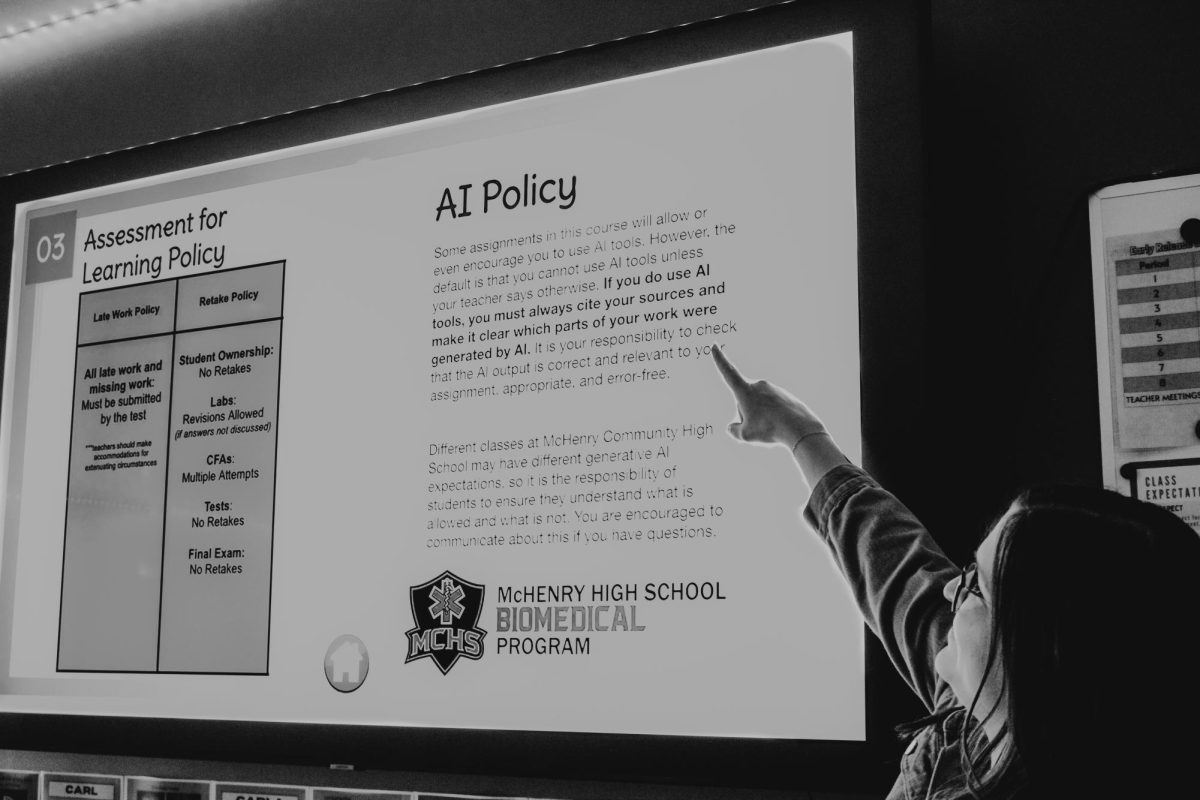

Over the course of this school year, MCHS’s AI committee has been working to specify the AI policy. While it is important for the school to have a clear stance on AI, the lack of specificity in the meantime has made students question what AI use is within policy.
According to a 2025 College Board study about the usage of AI across high schools, “while nearly all students are using generative AI tools, one in five high schools allow use but have no formal policy.”
The MCHS handbook states that, “the use of artificial intelligence as a substitute for original thought on academic work will be considered academic dishonesty.”
This policy is not very specific, so different departments around the school have added onto this policy to help guide students and teachers in the classroom.
English
The English Department does not completely turn away the use of AI for things like brainstorming and generating ideas for essays, however, these teachers must still be clear about appropriate use.
“You see a chart [in syllabi],” says English Division Chair Gina Nomikoudis, “and the teacher is supposed to explicitly state that AI is okay or AI won’t be okay.”
Mathematics
There are not very many opportunities for the application of AI tools in the Math Department.
“A student can choose to use AI on assignments,” says math teacher Micheal Meyer, “but that will not help when it comes time to complete an assessment in the classroom.”
According to Meyer, many teachers use the same or similar statements in their syllabi stating, “if you do use AI tools, you must always cite your sources and make it clear which parts of your work were generated by AI. It is your responsibility to check that the AI output is correct and relevant to your assignment, appropriate and error-free.”
Physical Education
AI applies to PE differently than most other departments since there isn’t much of a way to apply it to the actual class. The PE Department is mostly concerned with the use of AI glasses in the locker rooms.
“I think the biggest risk AI poses in PE,” says PE Division Chair Jennifer Beattie, “is the ability to capture images or videos inside the locker rooms.”
These glasses can pose significant safety risks, so they are strictly banned in locker rooms.
Science
There are no specific additions to the AI policy within the Science Department. This is partly because it doesn’t seem to be an issue in this department.
“ I personally have not been approached by teachers where appropriate usage of AI is an issue,” says Science Division Chair Tim Beagle. “To the best of my understanding AI is being used appropriately in science classes.”
World Languages and Fine Arts
The main concern regarding AI with language classes is the use of translators, but this has been a concern long before AI because of websites such as Google Translate. Because of this, the language classes are much more specific with how AI and translators should not be used.
“Using an online translator/AI,” says Fine Arts and World Languages Division Chair Megan Bennett, “even if it’s to translate one word or to use advanced grammar structures will result in a zero for the assignment/assessment until it is retaken, as well as parental and/or administrative contact.”
Social Science
The Social Science Department’s addition to the AI policy largely depends on the course. Some classes are much more restrictive than others, and it is mostly up to the teacher and how much students are trying to use AI in those courses.
“We do see students trying to abuse AI and pass that work off as their own,” says social science teacher and AI Committee member Eric Vollmert. “While we do feel that it’s not the majority of students, the issue does arise regularly and it can be very obvious.”
However, all teachers in this department are still supposed to have their policy clearly stated in the syllabus to avoid confusion.
Because of how much these departments differ, it can cause many students to confuse policies between classes.
MCHS’s AI Committee has been working all year to amend this problem, but AI technology and its application at school keeps changing. Because of this, they haven’t been able to come up with an all-encompassing policy yet.
“We brainstormed this policy collectively as a committee and have revised the language multiple times over the course of several meetings,” says Vollmert. “Our goal was to create a policy that maximizes the benefits of AI while minimizing the impact of any detrimental factors.”
The AI Committee is hopeful that by the end of the ‘25-’26 school year they will have a finalized version of MCHS’s AI policy.