


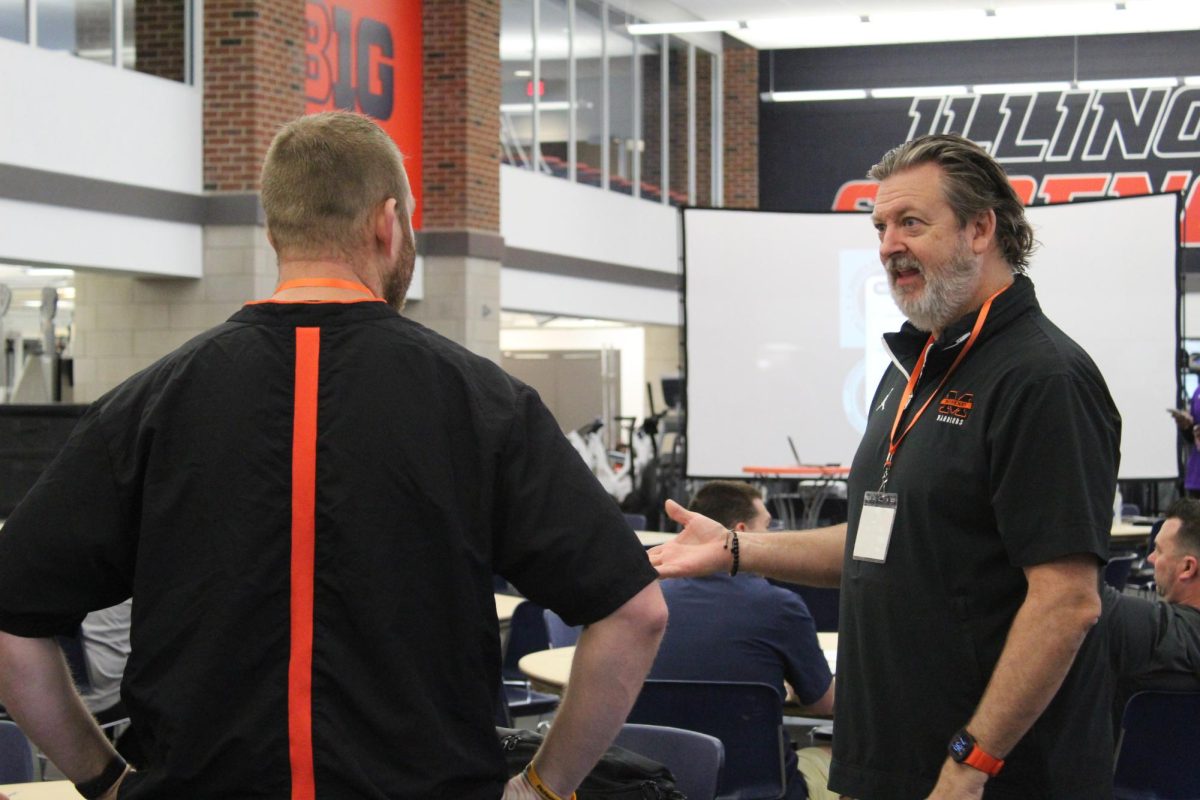

As the sun rises over the University of Illinois Urbana-Champaign, MCHS Head Strength Coach John Beerbower sets out name tags perfectly, one by one. Strength coaches from Illinois make their way to the weight room and gather. As Beerbower looks back at all the tables ready to be filled, he is sure that this is what he is meant to do.
With the assistance of Emily Schilling, Director of Strength and Conditioning for Olympic Sports at the University of Illinois, Beerbower helped organize the 2026 NHSSCA Illinois State Clinic for high school coaches. The panel and vendors allowed the coaches to make connections and learn how to better coach their athletes.
“We have a great team with us today,” Beerbower says, “and we are honored to be here.”
Beerbower’s goals for this event were for everyone to leave having met someone new, learned something new and make sure they had a good time. Nearly 102 people attended the clinic.
This event was organized in the weight room and the field house on campus. Main panelists included Frank Campbell, Tony Holler, Matt Cates, Adam Fletcher, Brad Jenisch and additional vendors. It’s made clear that whether it’s on the court, field or in the weight room, the panelists’ impact on their student-athletes is undeniable.
One of the main speakers for this event was Frank Campbell, Head Strength Coach and Speed Coach at Mascoutah High School. He has a Bachelor’s in Exercise Science as a professional for CSCS. His resume as a strength conditioning coach includes 10 years with the University of Arizona football strength staff before returning home to Mascoutah.
Coach Campbell’s presentation covered how to build speed qualities, acceleration, max velocity and power inside the weight room. Coaches learned how to identify and then apply fixes for key strength and power qualities that transfer to game speed, and how to train students using proven weight room, various other methods, and strategies.
Coach Adam Fletcher from the University of Illinois Fighting Illini men’s basketball and strength and conditioning spoke as well. Fletcher explained the concept of movement training, emphasizing the importance of working through a full range of motion and having kinesthetic awareness.
“If I can give anything to any athlete in high school,” Fletcher says, “I would give them low-level gymnastics and wrestling.”
Member of the Illinois Track and Field Hall of Fame and Co-director of Track Football Consortium, Coach Tony Holler was also a speaker. Holler created his high-performance training and coaching philosophy revolutionary “Feed the Cats” in 1999. In Holler’s segment, he teaches attendees how to implement the “Atomic Workout” and “X-Factor Workout.”
“Sprint, lift, jump, bounce and throw,” Holler says. “None of those things sound like golf, tennis or swimming, they hardly even sound like football, but they create better athletes, and better athletes are better players. We are not trying to create football players. Let the football coach do that. You need to train what football does not give kids.”
One thing all coaches in attendance at the event have in common is to be better, and their desire to be present in their athletes’ training, making a difference.
To end the day of lectures and presentations, lunch was provided. While coaches ate their barbecue, they were able to visit vendors and make small talk.
As coaches left the weight room, they felt enlightened and eager to go back to their schools with new lessons for their athletes.