


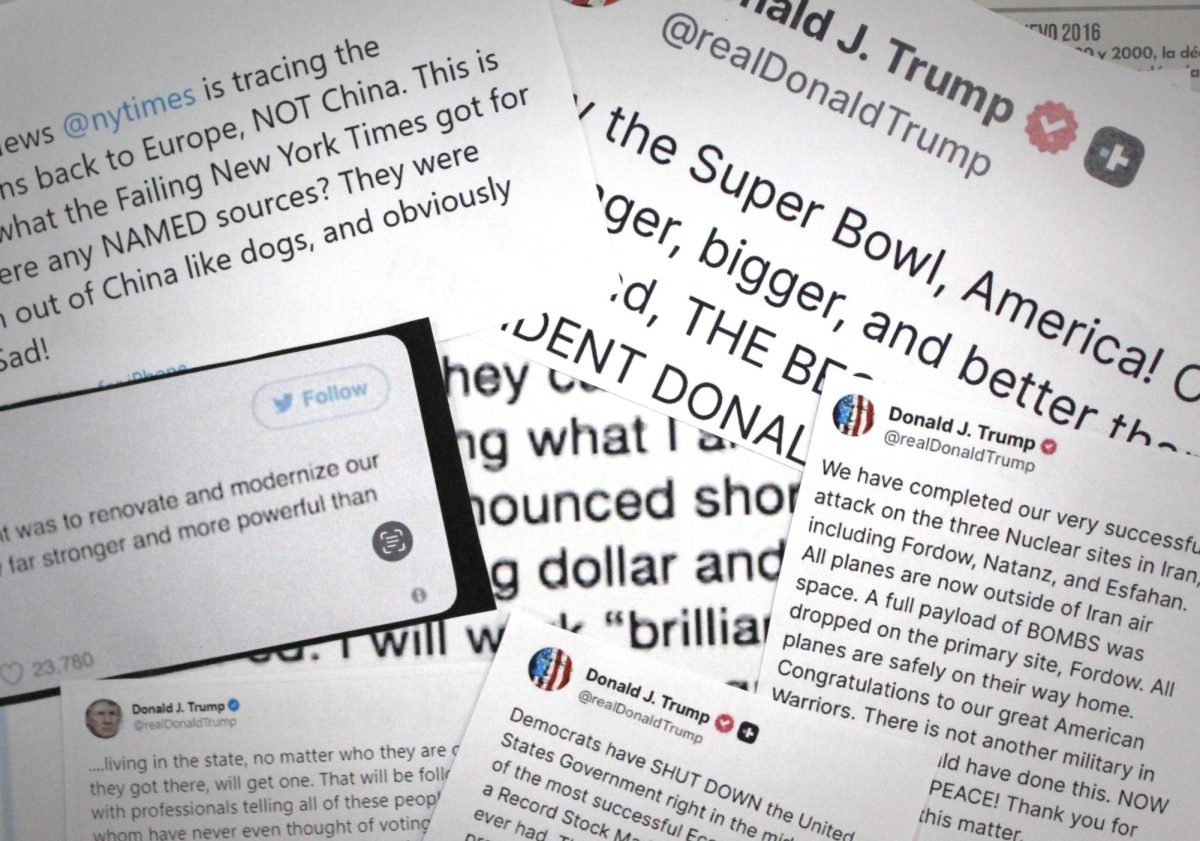

A high school student wakes up and opens X, the first thing they see is a post from President Donald Trump, explaining a new update about the ongoing war with Iran. This is the only thing the student has seen from Trump on the topic, but it should not be this way. Presidential news should not only be provided through social media.
Since Trump has become president, he has used social media, specifically X, as his main source of sharing information with the American public.
According to the Trump Tweet Archive, Trump has posted on X 50,022 times since he became president. 25% of these posts have been Trump saying his own name, 23% of them have included words such as democrats, liberals, leftists, Obama, Clinton, Biden, Schumer and Pelosi, and 11% have included negative words such as terrible or horrible, or insults like loser and stupid.
In the past, presidents have delivered important news through press conferences and news broadcasts, but Trump is an exception to this rule.
“Before social media, presidential speeches were more formal and controlled,” MCHS social science teacher Jonathan Niemic says. “For example, FDR spoke to the public through his ‘fireside chats’ on the radio. These speeches were planned ahead of time and often explained important issues in a clear way.”
American citizens, especially the younger generation, are receiving most of their political information through social media, but the full story is often lost.
“(Our generation) is not seeing (the news) from the standpoint of national news,” junior Ryan Anderson says, “they’re only seeing the lowlights of social media posts being made by political figures.”
As high schoolers, we are at the point in our lives where we can form our own political opinions, separate from parents and teachers. Because of this, it is important to realize that social media often only tells parts of the story, and we should make sure our sources are credible before letting social media posts impact our developing opinions.
“Social media has made presidential communication much faster and more direct,” Niemic says. “This means people can hear messages right away, without waiting for the news to report on it. At the same time, it also means messages aren’t always as carefully checked before being shared.”
Social media posting by the government has seriously diminished the severity of many issues in our country.
Most of these posts contain unserious trends and tones. Because of this, certain political issues aren’t taken as seriously as they should be. Examples of this include TikTok videos on the issue of ICE and deportation, which would often be graphic videos accompanied by trendy pop music.
But there are other negative possibilities from viewing political news through social media.
“Not all information is accurate, and important issues can get oversimplified,” Niemic says. “Social media can also create places where people mostly see opinions they already agree with.”
Political figures, especially the president, should be held to a higher standard of professionalism.
“I think (the president’s posts) are very unprofessional,” Anderson says. “I think that social media should be something that’s used for connections … I think (news) should stay on news feeds.”
The next time you see a post from the president, or any political figure, and think to yourself, “is this true?” Take a moment of your time to research a news article and see the bigger picture.